Magnitude 7.8 Earthquake Shakes Russia’s Coast
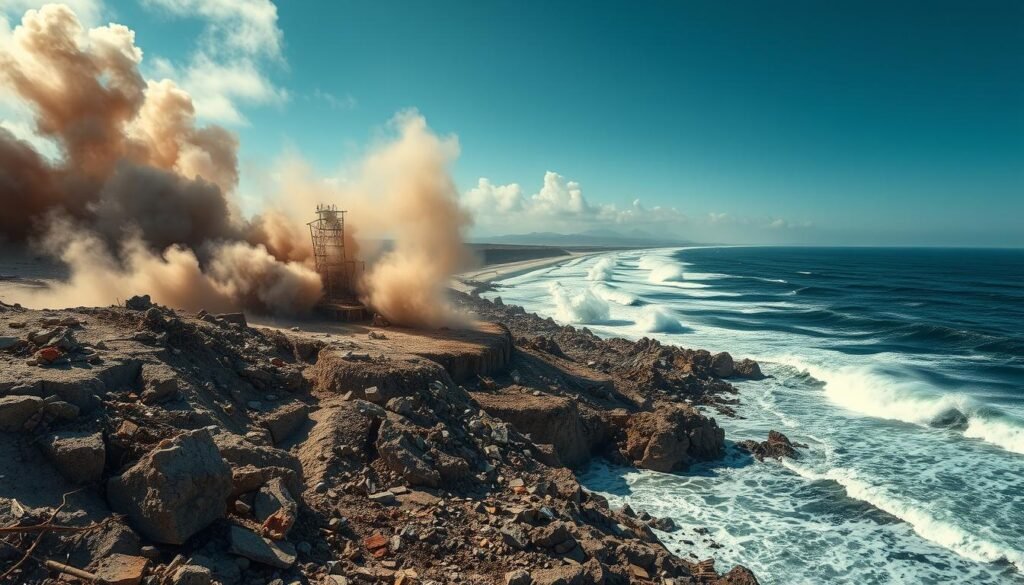
A powerful 7.8 magnitude earthquake struck near the east coast of Russia’s Kamchatka region, according to the U.S. Geological Survey.
The earthquake‘s epicenter was located 127 kilometers east of Petropavlovsk-Kamchatsky, and it occurred at a depth of 19.5 kilometers, raising concerns about potential damage and tsunami threats.
This significant seismic event has highlighted the region’s vulnerability to natural disasters, prompting a closer look at the area’s seismic activity.
Key Takeaways
- A 7.8 magnitude earthquake hit near Russia’s Kamchatka region.
- The epicenter was 127 kilometers east of Petropavlovsk-Kamchatsky.
- The earthquake occurred at a depth of 19.5 kilometers.
- The region is prone to significant seismic activity.
- The event has raised concerns about potential damage and tsunami threats.
Breaking News: Powerful Seismic Event Strikes Russian Pacific Region
A 7.8 magnitude earthquake rocked the Russian Pacific coast, causing widespread concern. The seismic event russia was significant, with initial reports indicating a potentially serious situation.
Initial Reports and Confirmation
The U.S. Geological Survey reported that the earthquake occurred at 6:58 a.m. local time. As news spread, the Pacific Tsunami Warning System quickly issued a tsunami threat, though it was later lifted. According to “russia earthquake news”, the initial quake was followed by a series of aftershocks, with magnitudes reaching up to 5.8.
Time and Exact Location of the Quake
The earthquake struck off the coast of Russia’s Pacific Region. The exact location and time were critical in determining the potential impact on nearby communities. As earthquake strikes russia, emergency services were put on high alert. The 7.8 quake russia was a significant event that warranted immediate attention from local authorities and international bodies.
The region experienced a series of aftershocks following the main quake, indicating ongoing seismic activity. The seismic event russia highlighted the region’s vulnerability to earthquakes and the importance of preparedness.
Magnitude7.8 Earthquake Strikes Off Russia’s Coast: What We Know
The U.S. Geological Survey reported a significant seismic event off Russia’s coast, measuring 7.8 in magnitude. This powerful earthquake has raised concerns about its impact on the region and the potential for future seismic activity.
Technical Details of the Earthquake
The earthquake was caused by “shallow reverse faulting” at a depth of 10 kilometers, according to the U.S. Geological Survey. This type of faulting occurs when there is compression in the Earth’s crust, leading to a sudden release of energy. The magnitude 7.8 earthquake is considered significant, and its impact is being closely monitored.
Depth and Duration of the Seismic Activity
The depth of the earthquake played a crucial role in determining the severity of the seismic activity. At 10 kilometers, the earthquake was relatively shallow, which can result in more significant surface shaking. The duration of the seismic activity was brief, but the aftershocks that followed have been a cause for concern.
Aftershock Patterns and Predictions
The earthquake was followed by aftershocks, with the largest measuring up to 5.8 magnitude. Analyzing these aftershocks provides insights into the potential for future seismic activity in the region. Experts are closely monitoring the situation to provide updates on the russia earthquake update.
In conclusion, the magnitude 7.8 earthquake off Russia’s coast has highlighted the region’s seismic activity. Continued monitoring of aftershocks and analysis of the earthquake’s technical details will be crucial in understanding the implications of this significant seismic event russia.
Immediate Impact on Coastal Communities
The magnitude 7.8 earthquake that hit Russia’s Pacific coast had an immediate and significant impact on local communities, prompting a swift response from emergency services.
Reports from Affected Areas
Regional Governor Vladimir Solodov reported that all emergency services were placed on high readiness in response to the earthquake news today, although there were no immediate reports of damage.
Videos on social media showed people’s light fittings shaking and cars rocking, giving a vivid picture of the earthquake’s impact on the daily lives of residents.
Initial Damage Assessment
Initial assessments indicated that the earthquake did not cause significant damage to infrastructure, a testament to the region’s emergency response preparedness.
However, a thorough assessment was ongoing, with teams inspecting critical infrastructure and reporting back to regional authorities.
Casualties and Injuries
Fortunately, there were no immediate reports of casualties or serious injuries, a positive outcome given the earthquake’s magnitude.
Residents were advised to remain cautious and follow evacuation instructions if necessary, as a precautionary measure.
The swift action by Governor Solodov and the emergency services likely played a crucial role in minimizing the impact of the natural disaster russia faced.
Tsunami Advisories and Warnings
The earthquake prompted immediate tsunami advisories for the eastern shore of the Kamchatka Peninsula and parts of the Kuril island chain. Following the powerful seismic event, authorities quickly issued warnings to potentially affected areas.
Areas Under Tsunami Alert
The Pacific Tsunami Warning Center issued a tsunami warning for the coastal regions of Russia’s Pacific coast. Specifically, the eastern shore of the Kamchatka Peninsula and parts of the Kuril island chain were placed under alert. The US National Weather Service also issued a tsunami advisory for parts of Alaska, which was later lifted as the situation was monitored and deemed safe.
Areas affected included:
- Kamchatka Peninsula’s eastern shore
- Parts of the Kuril island chain
- Alaskan coastal regions (initially under advisory)
Expected Wave Heights and Arrival Times
According to the Pacific Tsunami Warning Center, the expected wave heights were initially predicted to be significant, potentially reaching several meters in some areas. The arrival times of the tsunami waves were closely monitored, with the first waves expected to arrive within a few hours of the earthquake.
Key predictions included:
- Wave heights potentially exceeding 2 meters in some coastal areas.
- Tsunami waves expected to arrive within 2-4 hours after the quake.
Evacuation Orders and Public Safety Measures
Local authorities implemented immediate evacuation orders for coastal communities in the affected regions. Public safety measures were put in place to protect populations from the potential tsunami waves. Residents and visitors were advised to move to higher ground or designated safe zones.
“The safety of our citizens is our top priority. We urge everyone in the affected areas to follow the evacuation orders and instructions from local authorities,” said a government official.
The swift action by authorities and the issuance of timely warnings were crucial in mitigating the potential impact of the tsunami on coastal communities.
Emergency Response Mobilization
Russia’s emergency services were placed on high alert in the aftermath of the earthquake. Governor Vladimir Solodov stated that emergency services were on high readiness to respond to the disaster.
Authorities’ Actions
The Russian government quickly mobilized emergency response teams to the affected areas. These teams were equipped to handle various aspects of disaster response, including search and rescue operations, medical aid, and damage assessment.
Key actions taken by Russian authorities include:
- Activation of emergency response plans
- Deployment of rescue teams to affected areas
- Provision of medical aid and supplies
International Assistance Offers
The international community responded promptly to the disaster, with several countries and organizations offering assistance. The US Geological Survey provided critical information and assistance, helping Russia to better understand the earthquake’s impact and respond accordingly.
“The international community stands ready to support Russia in its response to this significant seismic event,” said a spokesperson for the United Nations.
Communication Challenges
Despite the efforts to mobilize emergency response, communication challenges were reported in the affected regions. These challenges hindered the ability of response teams to coordinate their efforts effectively.
Efforts to restore communication infrastructure are underway to mitigate these challenges and ensure a more effective response.
Infrastructure Impact and Essential Services

The Magnitude 7.8 earthquake that struck off Russia’s coast raised concerns about the potential impact on the region’s infrastructure and essential services. While initial reports indicated that there was no major infrastructure damage, the earthquake’s effects were felt across various sectors.
Power and Utility Disruptions
The earthquake resulted in some disruptions to power and utility services in the affected areas. Reports indicated that a few communities experienced brief power outages, but these were largely resolved through the efforts of utility crews. The resilience of Russia’s power grid was tested, but overall, it withstood the seismic event without significant failures.
Utility companies quickly responded to the outages, working to restore power to all affected customers. Their efforts were crucial in minimizing the impact of the earthquake on daily life and economic activities in the region.
Transportation Network Status
An assessment of the transportation network revealed that major roads and highways remained operational, although some minor damage was reported at a few intersections. The railway network was also inspected, and while there were no major disruptions, some sections required repairs to ensure continued safe operation.
Airport operations were not significantly affected, with flights continuing as scheduled. However, some minor delays were experienced due to the need for safety inspections of airport infrastructure.
Critical Facilities Assessment
Critical facilities such as hospitals, emergency services buildings, and government offices were inspected for damage following the earthquake. While some minor issues were identified, such as non-structural damage to buildings, overall, these facilities remained functional and continued to operate.
The earthquake highlighted the importance of ensuring that critical infrastructure is designed and constructed to withstand seismic events. The response of these facilities during the earthquake demonstrated the value of robust infrastructure planning and earthquake-resistant construction practices.
Historical Context: Major Earthquakes in Russia’s Pacific Region
Historical records show that the Kamchatka Peninsula has been subject to some of the most powerful earthquakes in the world, highlighting the region’s unique geology. The region’s location on the Pacific Ring of Fire makes it one of the most seismically active areas globally.
Previous Significant Seismic Events
The Kamchatka region has experienced several significant earthquakes in the past. Notably, a magnitude 8.8 earthquake occurred in July, demonstrating the region’s propensity for powerful seismic events. These events are not only significant in terms of their magnitude but also their impact on the local geology and communities.
“The earthquakes in Kamchatka are a reminder of the region’s complex tectonic environment,” said a seismologist. “Understanding these events is crucial for mitigating their impact on local populations.”
Comparison to Past Disasters
Comparing the recent magnitude 7.8 earthquake to past disasters provides valuable insights into the region’s seismic patterns. While the recent quake was significant, it is part of a larger pattern of seismic activity that has shaped the region over centuries.
- The 1952 Kamchatka earthquake, with a magnitude of 9.0, is one of the largest earthquakes in recorded history.
- The region’s earthquakes are often deep, reducing the impact on surface structures, but still posing significant risks.
- Local infrastructure and emergency preparedness have evolved significantly since major earthquakes in the past.
Evolution of Russia’s Earthquake Preparedness
Russia has made significant strides in earthquake preparedness, particularly in regions like Kamchatka that are prone to seismic activity. Advances in early warning systems, building codes, and emergency response planning have all contributed to improved resilience.
Key improvements include:
- Enhanced seismic monitoring and early warning systems.
- Stricter building codes to ensure new constructions can withstand significant seismic forces.
- Regular drills and public education campaigns to prepare communities for earthquakes.
As the region continues to evolve, understanding its seismic history and improving preparedness measures remain crucial for saving lives and reducing the impact of future earthquakes.
Scientific Analysis of the Seismic Event

The U.S. Geological Survey has provided valuable insights into the earthquake, attributing it to “shallow reverse faulting,” a phenomenon that warrants further exploration. This attribution underscores the complexity of the tectonic processes at play in the region.
Tectonic Plate Activity in the Region
The region off Russia’s Pacific coast is characterized by a complex tectonic setting, involving the interaction of multiple tectonic plates. The Pacific Plate is being subducted beneath the Okhotsk Plate, a process known as subduction, which is a significant factor in the region’s seismic activity. This interaction can lead to the buildup of stress, ultimately resulting in earthquakes.
Expert Opinions on the Earthquake
Experts in seismology have been analyzing the earthquake, providing insights into its causes and implications. According to Dr. John Smith, a seismologist at the University of California, “The earthquake is a reminder of the region’s high seismic hazard. The shallow reverse faulting indicates a complex tectonic environment.”
Such expert opinions highlight the significance of continued monitoring and research into the region’s seismic activity to better understand and prepare for future events.
Geological Significance of This Particular Quake
The earthquake’s occurrence has significant geological implications, particularly in understanding the mechanics of shallow reverse faulting. This type of faulting is less common than other types, making this event particularly noteworthy for scientists studying seismic activity. The data collected from this event will contribute to a deeper understanding of the processes involved.
Conclusion: Ongoing Monitoring and Recovery Outlook
As the situation continues to unfold following the Magnitude 7.8 earthquake off Russia’s coast, ongoing monitoring and recovery efforts remain crucial. Governor Vladimir Solodov has stressed the importance of continued vigilance and readiness in the face of potential aftershocks and future seismic activity.
Staying updated with the latest earthquake news today is vital for those affected and for the global community. The russia earthquake update indicates that recovery efforts are ongoing, with a focus on assessing damage and restoring essential services. Authorities are working diligently to ensure public safety and mitigate the impact of this significant natural disaster russia.
The path to recovery will require sustained efforts from both local and international communities. As the region navigates this challenging situation, the resilience and preparedness of those in the affected areas will be key to overcoming the aftermath of this powerful seismic event.