Valve Announces New Steam Machine Console: Price, Specs, Release Date, and Why It Might Finally Work
Valve Announces New Steam Machine Console: Price, Specs, Release Date, and Why It Might Finally Work
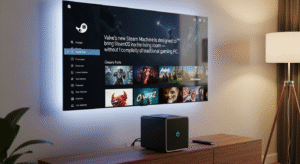
After years of speculation and nearly a decade since its first failed attempt, Valve is back with a bold new vision for the living room: the **next-generation Steam Machine**. Paired with a redesigned **Steam Controller** and powered by a matured **SteamOS**, Valve believes the timing is finally right to bring PC gaming to the couch—effortlessly, affordably, and at scale.
But is this another misstep like the original Steam Machines of 2015, or has Valve truly cracked the code this time?
A New Chapter for a Familiar Idea
Valve first introduced the Steam Machine concept in 2013—a series of third-party-built mini PCs designed to run SteamOS and bring PC gaming to TVs. Despite ambitious goals and partnerships with manufacturers like Alienware and Zotac, the initiative fizzled out within a few years. Gamers were confused by inconsistent hardware, developers showed lukewarm support, and the underlying SteamOS lacked the polish needed for mainstream adoption.
Fast-forward to 2025, and Valve is trying again—but this time, it’s different.
“There’s a lot we learned from the Steam Deck,” says Pierre-Loup Griffais, software engineer at Valve, in an exclusive interview with IGN. “Between shipping a successful handheld and making huge strides with Proton and game compatibility, it just felt like the right time.”
Indeed, the **Steam Deck**—Valve’s handheld PC released in 2022—has sold millions of units and redefined expectations for portable PC gaming. But it also revealed something unexpected: **a significant number of users were docking their Decks to play on the big screen**.
According to Valve’s internal data, **10–15% of Steam Decks are regularly connected to external displays**. More importantly, user feedback consistently expressed a desire for **better performance, sharper visuals, and more comfortable controls** when playing from the couch.
Enter the Steam Machine.
What Is the Steam Machine?
The new Steam Machine is a **compact, living room–optimized PC** that runs **SteamOS 3.0**—the same Linux-based operating system that powers the Steam Deck. But unlike its predecessor, this isn’t a reference design for third parties. Valve is building and selling the hardware directly, ensuring a **consistent, curated experience**.
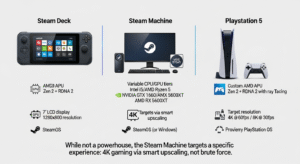
“It’s not about raw power,” explains Yazan Aldehayyat, hardware engineer at Valve. “It’s about delivering a 4K/60fps experience for every game on Steam—using upscaling where needed—while keeping the system affordable and simple.”
That philosophy explains the machine’s restrained specs. While Valve hasn’t revealed the exact CPU and GPU models (likely a custom AMD Ryzen APU paired with a mid-tier discrete GPU), they’ve shared key performance targets:
– **Target resolution**: 4K at 60Hz using FSR or other upscaling tech
– **Power supply**: ~200 watts
– **Form factor**: Compact cube, designed for AV racks
– **Storage options**: Two variants (likely 1TB and 2TB NVMe SSDs)
– **OS**: SteamOS 3.5
PC Gamer’s hardware editor Jacob Ridley described the system as “fairly underpowered”—and that’s by design.
As Michael Douse, Publishing Director at Larian Studios (makers of Baldur’s Gate 3), put it on X:
> “Genuinely no point making a high-spec Steam Machine. Anyone who wants more demanding hardware on their TV is part of the audience who know how to turn any PC into a Steam Machine.”
In other words: Valve isn’t targeting enthusiasts with water-cooled rigs. They’re targeting **casual and mainstream gamers who just want to press a button and play**.
Performance Verification: Steam Deck Verified, But for the Living Room
One of the Steam Deck’s greatest innovations was the **“Verified” badge system**—a clear, user-friendly way to know if a game runs well on the device.
The Steam Machine will have its **own Verified program**, with separate badges from the Deck. As Griffais explains:
> “If a game isn’t great on Steam Deck, it might still run beautifully on the Steam Machine—and vice versa. We’ll test each platform individually.”
This means developers can optimize for the Steam Machine’s higher performance envelope, while players get **clear guidance without needing to research frame rates or driver issues**.
Moreover, Valve is expanding its Steamworks API so games can **detect whether they’re running on a Steam Machine** and automatically apply ideal settings—just as many already do for the Steam Deck.
SteamOS: Now Ready for Prime Time
The original Steam Machines failed partly because SteamOS was immature. Today, **SteamOS is battle-tested**. Powered by **Proton**, it supports **over 90% of the top 1,000 Steam games**—many with full controller support and seamless performance.
“We’ve been fixing boot issues for the latest AMD CPUs and adding Intel Lunar Lake support,” says Griffais. “We’re constantly expanding hardware compatibility because we want SteamOS to eventually run on any PC.”
For now, the Steam Machine is the **gold standard** for that experience—fully integrated, fully supported, and fully optimized.
Meet the New Steam Controller
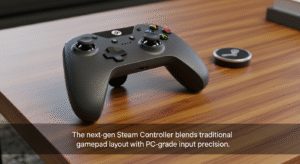
No Steam Machine is complete without its companion: the **all-new Steam Controller**.
Unlike the polarizing original, this version **marries familiarity with innovation**:
– **Traditional dual analog sticks**—but upgraded to **magnetic, high-precision** sensors
– **Four rear grip buttons** for reload/sprint without claw grip
– **Advanced haptics** with “high-definition” rumble
– **Capacitive trackpads** for mouse-like aiming or radial menus
– **Built-in gyro** with **touch-activated motion controls**
– **35+ hours of battery life**
– **Proprietary 2.4GHz wireless** via a magnetic “puck” with **8ms latency**—even with four controllers
Valve is also bringing back **Steam Input**, its powerful customization engine, and will update *Aperture Hand Lab* as a tutorial—but **no new flagship game** is planned.
Price and Release Date: The Critical Unknowns
As of November 2025, Valve has **not announced an official price or release date**.
However, affordability is a top priority. Analysts speculate the base model could launch **between $599 and $799**, possibly as a **holiday 2026 release**.
Why This Could Succeed Where the Original Failed
The original Steam Machines suffered from **fragmentation**. This time, Valve is taking a page from the **Steam Deck playbook**:
✅ One hardware spec
✅ Fully integrated OS and store
✅ Verified program
✅ Fast suspend/resume
✅ CEC support (one-button TV wake-up)
✅ Background updates + cloud sync
“It’s about eliminating every friction point,” says Aldehayyat. “How fast can we get you from couch to gameplay? That’s the metric.”
The Bigger Vision: A Storefront War, Not a Hardware War
Michael Douse believes Valve’s move could shift the “war for the living room” from **branded consoles** to **competing storefronts**—with dozens of manufacturers building SteamOS or Xbox OS devices.
“If Valve can once again normalize and thus create that entry point,” Douse writes, “there is potential for big growth in that new market.”
Final Thoughts: Simplicity Is the New Power
Valve isn’t trying to beat the PS5. They’re building a **“just works” box** for millions who want to play *Stardew Valley* or *Elden Ring* from the couch—without tweaking settings or Googling error codes.
As Griffais puts it:
> “We’re not looking at consoles. We’re solving problems for PC gamers—especially the ones who want to play in the living room.”
With mature software, thoughtful hardware, and hard-won lessons from the Steam Deck, Valve might finally have the formula right.
The Steam Machine isn’t about specs.
It’s about **access**.
And sometimes, that’s more powerful than teraflops.

*Stay tuned for official pricing and release details.*